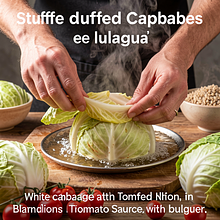
Remove the outer leaves of the cabbage head (3–4 leaves) if they are dirty or damaged. Place the head on a cutting board with the base facing down and cut around the core with a sharp knife to remove the tough core to a depth of about 2–3 cm. This will make it easier to separate the individual leaves.
Description
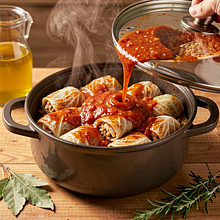
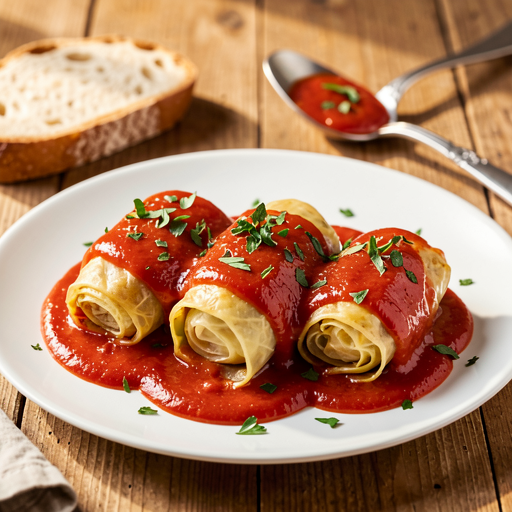
Traditional Polish stuffed cabbage rolls in a modern twist: instead of rice, we use spelt, which gives the dish a grainy texture and a deeper, nutty flavor. Cabbage rolls are wrapped cabbage leaves filled with a meat mixture with groats and vegetables, simmered in an aromatic tomato sauce. The recipe combines homey comfort with a touch of regional simplicity – spelt is popular in Polish kitchens, and the tomato sauce can be enriched with cream or sautéed bacon. The dish pairs perfectly with boiled potatoes, sautéed cabbage, or simply fresh bread. Visually: golden cabbage rolls, red, shiny sauce, and green parsley leaves provide contrast and an appetizing appearance.
Ingredients Used
Ingredients (19)
- White cabbage 1200 g
- Ground pork 500 g
- Barley groats 150 g
- Chicken egg 2 szt. (~120 g)
- Onion 1 szt. (~150 g)
- Garlic 3 ząbki (~15 g)
- Carrot 1.9 szt. (~150 g)
- Rapeseed oil 30 g
- Butter 30 g
- Tomato 6.7 szt. (~800 g)
- Vegetable broth 500 ml
- Wheat flour 15 g
- 🌿 Przyprawy
- Salt 0.2 szczypt (~5 g)
- Black pepper 4 szczypty (~2 g)
- Marjoram 2 g
- Bay leaf 6.7 szt. (~2 g)
- Parsley 30 g
- ✨ Opcjonalne
- Smoked bacon 100 g
- 18% cream 100 ml
💡 Kliknij na składnik aby oznaczyć jako użyty
Preparation steps
Preparing the cabbage
Bring a large pot of water to a boil (about 4–5 liters). When the water is boiling, immerse the head of cabbage for 3–4 minutes, turning every 30 seconds, until the outer leaves become flexible and easy to peel off. Remove the cabbage with tongs and set aside to cool. If the leaves are still stiff, immerse again for 1–2 minutes.
Preparing the filling
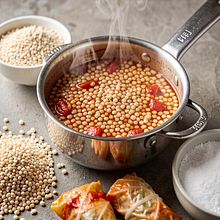
Rinse the pearl barley under cold water in a colander, transfer it to a small pot and cover with 300 ml of water. Add a pinch of salt. Bring to a boil, reduce the heat and cook covered for 20–25 minutes until the barley is tender but still has a slight bite. After cooking, drain any excess water and let it cool.
Peel the onion and chop it finely. Peel the carrot and grate it on a coarse grater. In a pan, heat 15 g of butter and 15 g of rapeseed oil over medium heat. Add the onion and sauté for 4–5 minutes until it becomes translucent and slightly golden. Add the carrot and sauté for another 4 minutes. Finally, add the minced garlic and sauté for 30 seconds until it releases its aroma.
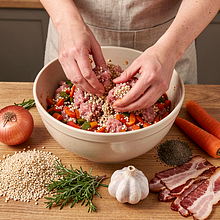
In a large bowl, combine the cooled pearl barley, sautéed vegetables, ground pork, beaten egg, marjoram, 3 g of salt, and 1 g of pepper. Mix by hand or with a wooden spoon evenly for about 2–3 minutes, until the ingredients are combined and the filling is cohesive.
Shaping the cabbage rolls
Trim the thick vein at the base of each leaf with a knife (thin fiber) to make it easier to roll the leaf. Place a portion of filling (about 60–80 g) in the center of the leaf, spread it along the middle, fold the sides inward, and roll tightly from the base to the top, forming a stuffed cabbage. Repeat until the filling and leaves are used up.
Layering and braising
In a large, wide pot or cast iron dish, place a few cut cabbage leaf edges at the bottom (they will serve as a base). Arrange the stuffed cabbage tightly, side by side, seam side down, in one or two layers. Pour in 200 ml of vegetable broth (just enough to cover the bottom by 1–2 cm), cover with a lid, and set over low heat.
Tomato sauce
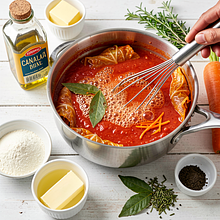
In a separate saucepan, heat 15 g of rapeseed oil and 15 g of butter over medium heat. Add a tablespoon of flour (15 g) and stir for 1–2 minutes until the flour is lightly browned (be careful not to burn it). Gradually pour in the tomatoes (800 g) and 300 ml of vegetable broth, continuously mixing with a whisk to break up any lumps. Add the grated carrot (the remaining part if any), bay leaf, 2 g of marjoram, 2 g of salt, and 1 g of pepper. Bring to a gentle boil, then simmer on low heat for 10 minutes.
Stewing cabbage rolls
When the sauce is ready, gently pour it over the stuffed cabbage rolls in the pot so that they are covered to about 2/3 of their height. Season with salt and pepper if needed. Cover with a lid and simmer on very low heat for 35–40 minutes. After 20 minutes, check if there is enough liquid; if the sauce is evaporating too much, add 50–100 ml of broth.
Finishing the sauce
After simmering, taste the sauce. If you want to lighten it, remove the pot from the heat for 1 minute, then stir in 100 g of 18% cream (optional) and gently bring to a boil for 1 minute, but do not let it boil over high heat. Remove the bay leaf before serving.
Serving
Transfer the stuffed cabbage rolls to a plate without breaking the wrapping. Generously drizzle with hot tomato sauce. Sprinkle with finely chopped parsley just before serving.
Final tips
If the stuffed cabbage rolls are cooling, leave them covered for a while; the sauce will thicken and the flavors will meld — then reheat on low heat for 5–7 minutes before serving. Store any unused cabbage rolls in the refrigerator in an airtight container for up to 3 days or freeze individual portions for up to 3 months.
Fun Fact
Stuffed cabbage rolls are one of the most versatile dishes in Polish cuisine — regional variations include different grains instead of rice (e.g. barley, buckwheat), and the name 'gołąbki' likely comes from the rolled shape resembling a small bird.
Best for
Tips
Serve with mashed potatoes or young potatoes with dill. You can add a tablespoon of sour cream to the sauce just before serving to balance the acidity. For a meatless version, replace the minced meat with a mixture of sautéed mushrooms and more spelt.
Store in the refrigerator in an airtight container for up to 3 days. For freezing, it's best to arrange single portions in containers at -18°C; thawed portions should be heated slowly over low heat. The sauce can be stored separately to avoid softening the leaves.
📸 Ugotowane przez społeczność
Zaloguj się, aby dodać zdjęcieDodaj zdjęcie gotowej potrawy
Po zatwierdzeniu przez moderatora otrzymasz 10 punktów doświadczenia.
Nikt jeszcze nie dodał zdjęcia. Bądź pierwszy!
Comments (0)
Be the first to comment on this recipe!
Add a comment