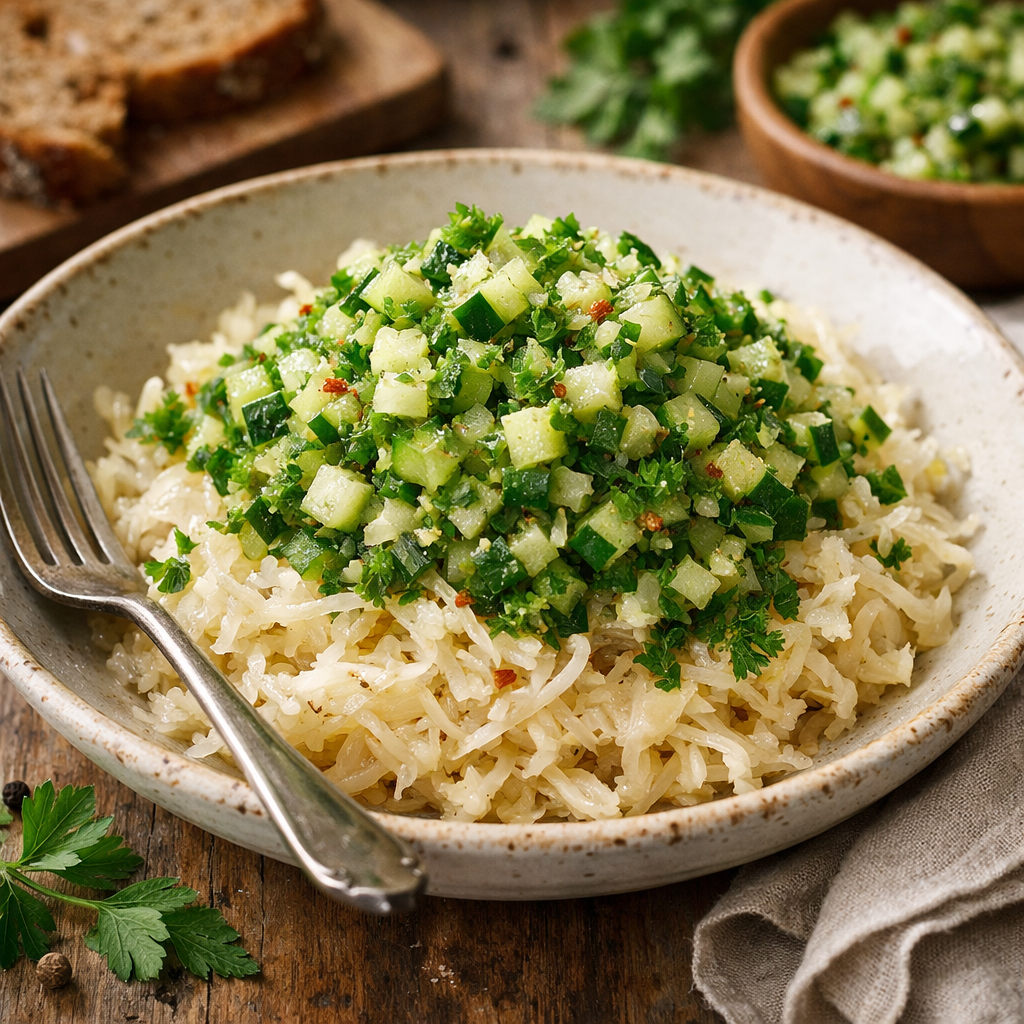
Sauerkraut and Cucumber Relish with Parsley

Additions Regional Cuisine of Poland Additions 45 min Medium 24 wyświetleń ~12.21 PLN * - (0)
Rate:
(0)
Start Cooking

Description

Sauerkraut and cucumber relish with parsley is an aromatic, slightly spicy addition to meats, roasted potatoes, and sandwiches. It is based on Polish winter preserves: sauerkraut and cucumbers, complemented by fresh parsley and a sweet-sour apple for flavor balance. The consistency is finely chopped — suitable as a salad addition or a winter sauce for poultry and cold cuts. The relish has a distinct salty-sour character with a gentle sweetness from honey and the depth of mustard; it looks appetizing thanks to the green accents of parsley and pieces of cucumber. The recipe includes techniques for draining, finely chopping, and seasoning, as well as storage tips in jars.

Ingredients Used

Ingredients (12)

Servings:
4
  • Sauerkraut 500 g
  • Pickled cucumber 2 szt. (~200 g)
  • Onion 1 szt. (~150 g)
  • Apple 0.8 szt. (~150 g)
  • Rapeseed oil 30 g
  • Honey 15 ml
  • Mustard 15 g
  • 🌿 Przyprawy
  • Parsley 30 g
  • Salt 2 g
  • Black pepper 2 szczypty (~1 g)
  • ✨ Opcjonalne
  • Cumin 2 g
  • Horseradish 20 g
💰 Szacowany koszt dania: ~12.21 PLN (3.05 PLN/porcję)
* Brak cen dla niektórych składników

💡 Kliknij na składnik aby oznaczyć jako użyty

Preparation steps

Ingredient Preparation

1

Prepare your workspace: wash and dry the countertop. Get a cutting board (preferably plastic), a sharp chef's knife, a bowl for draining, and a colander. Arrange all the ingredients in front of you.

Tool: sharp knife (20 cm) and cutting board. Common mistake: using a dull knife leads to imprecise cutting and mashing the ingredients instead of slicing them.
Cabbage

2

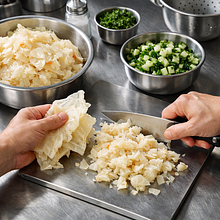
Take the sauerkraut (500 g). If it is in large leaves, tear them by hand and chop or dice them as finely as you like: first fold a few leaves in half and, cutting across, make thin strips. If the cabbage is very watery, place it in a colander and squeeze it with your hands or transfer it to a large cloth and wring out the liquid tightly. Draining: gently squeeze in batches for 1–2 minutes until it stops dripping.

Ingredients: Sauerkraut
Use a large bowl to collect the chopped cabbage. Note: do not discard the juice — if the relish is too thick, add a little juice for acidity.

Cucumber

3

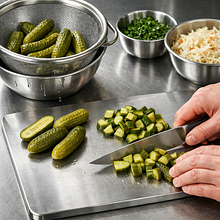
Drain the pickled cucumbers (200 g) from the brine, cut them in half lengthwise, and then slice each half into thin half-moons or small cubes, depending on your preferred relish texture. If the cucumbers have a lot of seeds, gently remove them with a teaspoon before cutting.

Ingredients: Pickled cucumber
Tool: vegetable knife and small spoon for removing seeds. Half-moon slices give a clearer texture, while diced pieces create a more uniform relish.

Onion and apple

4

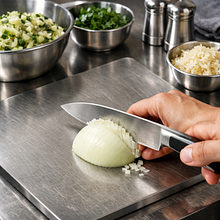
Peel the onion (150 g). Cut it in half, place the flat side on the board, and make small cuts lengthwise and crosswise, then chop it into small cubes. Peel the apple (150 g), remove the core, and also chop it into small cubes. The small pieces of apple will distribute the sweetness evenly.

Ingredients: Onion, Apple
Recommended tool: sharp knife and a small bowl for peels. Common mistake: too thick pieces of apple contrast with finely chopped cabbage — ensure similar cutting size.

Parsley

5

Tear the parsley leaves (30 g) from the thicker stems. Stack the leaves, roll them up, and chop very finely using the "one, two, one" technique (moving the knife blade back and forth over the leaves). Chop until you achieve small, green pieces.

Ingredients: Parsley
Tool: smaller herb knife or cleaver. Note: you can finely chop the hard, white stems and add them to the relish, but remove the thicker parts.

Mixing and seasoning

6

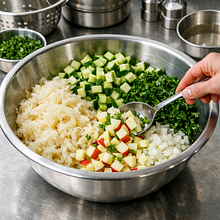
In a large bowl, combine the drained cabbage, chopped cucumbers, onion, apple, and chopped parsley. Add canola oil (30 g), mustard (15 g), and honey (15 g). Using a large spoon or spatula, mix vigorously for 1–2 minutes to ensure the ingredients are well combined and the oil lightly coats the pieces. Taste the relish and gradually add salt (2 g) and black pepper (1 g) to your liking. If desired, optionally add caraway seeds (2 g) lightly crushed in a mortar and horseradish (20 g) grated finely.

Ingredients: Sauerkraut, Pickled cucumber, Parsley, Onion, Apple, Rapeseed oil, Honey, Mustard, Salt, Black pepper, Cumin, horseradish
Tool: large bowl and wooden spoon. Key tip: stir until the honey and mustard are evenly combined — lift the ingredients with the spoon and mix from the bottom up.

Adjusting the consistency

7

Check the consistency of the relish: if it seems too dry, add 1–2 tablespoons of cabbage juice or a little water; if too runny, let it sit for 10 minutes — the cabbage and cucumber will draw out some moisture. Taste again and adjust the seasonings — the acidity of the cabbage may vary, so season carefully.

Ingredients: Sauerkraut
Use a measuring cup to add liquids in 15 ml increments. A common mistake: adding too much juice at once — it then becomes difficult to thicken the relish.

Setting aside and maturing the flavor

8

Cover the bowl with plastic wrap or a plate and let it sit at room temperature for 20–30 minutes to allow the flavors to meld. For a deeper flavor, you can chill the relish in the refrigerator for a few hours or overnight — this will round out the flavors.

Container: cover the bowl with plastic wrap or a lid. Note: do not store at room temperature for long — after 2 hours, refrigerate if not serving immediately.

Serving and storing

9

Serve the relish in a bowl as an accompaniment to roasted meats, cold cuts, potatoes, or sandwiches. If you prepare more than you need, transfer it to sterilized jars and seal. Store in the refrigerator for up to 7 days; the flavor is fresh right after preparation, and more harmonized after 24 hours.

Tools: clean jars and a tablespoon for filling. Common mistake: not sterilizing jars for long-term storage — always sterilize containers if you want to extend shelf life.

Fun Fact

💡

In Poland, pickled vegetables are used not only as winter preserves; preparing dips and relishes from pickles is a tradition meant to add freshness and acidity to heavier winter dishes.

Best for

Tips

🍽️ Serving

Serve chilled or at room temperature. It pairs well with roasted duck, pork loin, cold cuts, and also with cottage cheese as a winter snack. For contrast in textures, serve alongside crispy bread.

🥡 Storage

Store in sterilized jars in the refrigerator for up to 7 days. If you want to extend the shelf life, pasteurize the jars for 10 minutes in a water bath (jars covered with water), and then cool. Do not freeze sauerkraut directly, as it will lose its texture.

📸 Ugotowane przez społeczność

Zaloguj się, aby dodać zdjęcie
Dodaj zdjęcie gotowej potrawy

Po zatwierdzeniu przez moderatora otrzymasz 10 punktów doświadczenia.

🍲

Nikt jeszcze nie dodał zdjęcia. Bądź pierwszy!

Comments (0)

Be the first to comment on this recipe!

Add a comment

You might also like

Recipe Categories

Additions
Additions in: New Year's Eve

Side dishes should complement the main courses, introducing variety and color to the New Year's table.

See all recipes in this category

Traditional recipes from various regions of Poland that showcase the richness of local flavors and ingredients.

See all recipes in this category
Additions
Additions in: Valentine's Day

Delicious additions that will enhance the main dishes and enrich the Valentine's table.

See all recipes in this category
Reklama